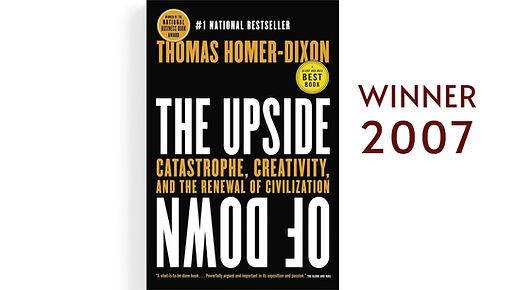
The Upside of Down: Catastrophe, Creativity, and the Renewal of Civilization
By Thomas Homer-Dixon
The Upside of Down: Catastrophe, Creativity, and the Renewal of Civilization predicts a coming breakdown in national and global order. In his book, Homer-Dixon presents a theory of the growth, crisis, and renewal of societies, arguing that today’s converging energy, environmental, and political-economic stresses could cause a breakdown of national and global order. This could result in a kind of social earthquake that could negatively impact billions of people.
Tectonic stresses, says Homer-Dixon, are largely unseen pressures building up under the surface of our world, and could eventually erupt into real threats in the future. A cluster of these concurrent threats is emerging — including:
energy stress, especially from increasing scarcity of conventional oil;
economic stress from greater global economic instability and widening income gaps between rich and poor;
demographic stress from differentials in population growth rates between rich and poor societies and from expansion of megacities in poor societies;
environmental stress from worsening damage to land, water forests, and fisheries; and,
climate stress from changes in the composition of Earth’s atmosphere.
Energy stress is particularly important because when energy is scarce and costly, everything a society tries to do — including growing its food, obtaining enough fresh water, transmitting and processing information, and defending itself — becomes harder.
According to Homer-Dixon, we are steadily expending more energy to get energy — known as the “energy return on investment”. This has critical global implications because we’re using a large proportion of our capital, wealth and economies just to produce energy, so we have less left over to tackle our increasingly difficult problems such as climate change.
The good news is, however, that this is not an inevitable outcome. There are things we can do now to keep this breakdown from becoming catastrophic. And some kinds of breakdown could even open up extraordinary opportunities for creative, bold reform of our societies, if we’re prepared to exploit these opportunities when they arise.
Thomas Homer-Dixon is Director of the Trudeau Centre for Peace and Conflict Studies and Professor in the Department of Political Science at the University of Toronto.
He was born in Victoria, British Columbia and received his B.A. in political science from Carleton University in 1980 and his Ph.D. from MIT in international relations and defense and arms control policy in 1989. He then moved to the University of Toronto to lead several research projects studying the links between environmental stress and violence in developing countries. Recently, his research has focused on threats to global security in the 21st century and on how societies adapt to complex economic, ecological, and technological change.
His books include The Ingenuity Gap, which won the 2001 Governor General’s Non-fiction Award, and Environment, Scarcity, and Violence, which won the Caldwell Prize of the American Political Science Association.